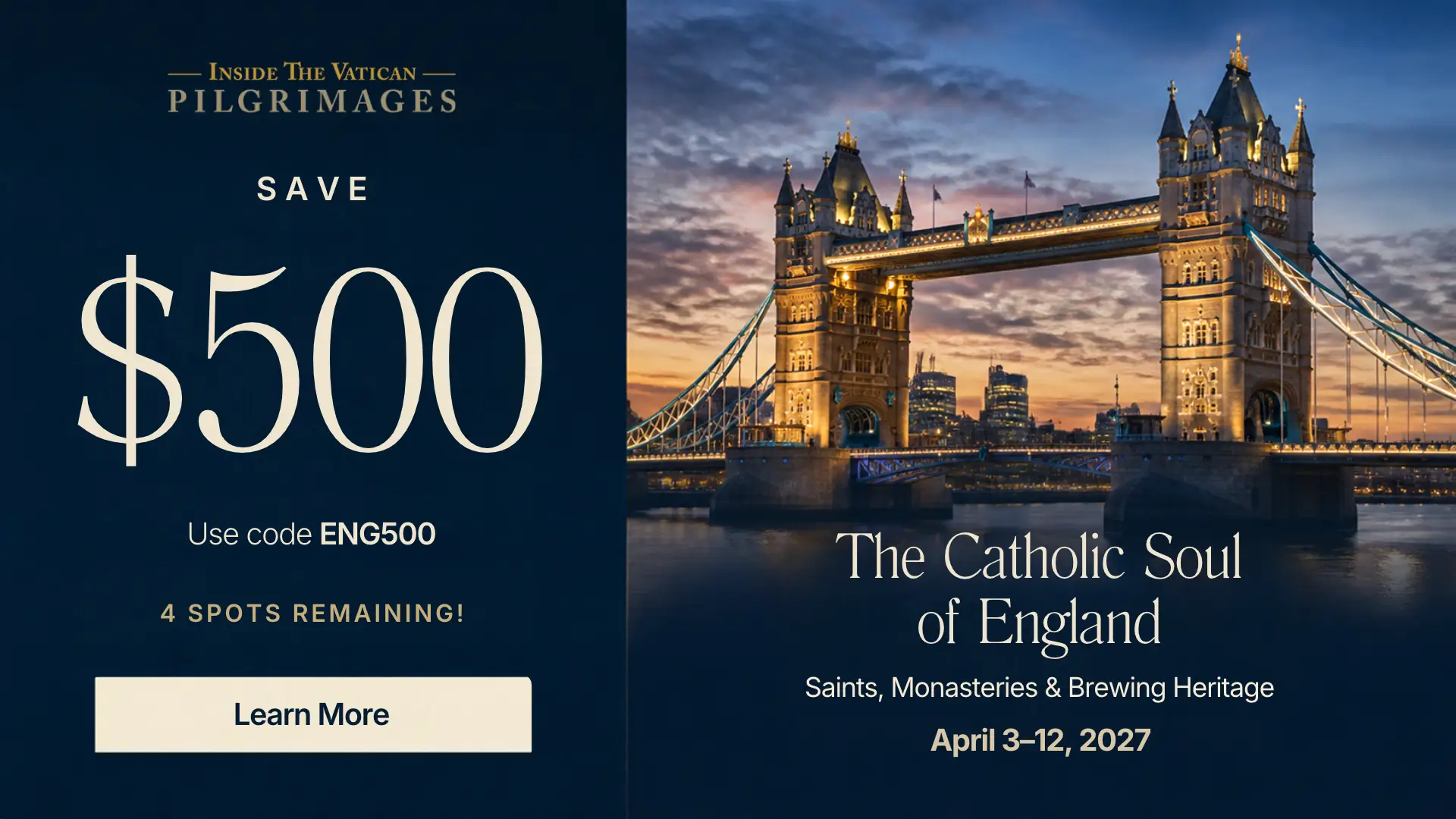
What does it mean to be a pilgrim in a city where the history of Christianity is woven into the stones of ancient churches, the lives of saints, the legacy of royal power, and the witness of those who suffered for their faith?
In April 2027, Inside the Vatican Pilgrimages travels to England, with a memorable day in London devoted to some of the most significant religious landmarks in the British capital. From the magnificent mosaics of Westminster Cathedral to the medieval splendour of Westminster Abbey, from the historic parish church of St Margaret’s to the contemplative refuge of Tyburn Convent, this journey offers far more than sightseeing. It is an opportunity to encounter the living Catholic faith within a landscape shaped by centuries of devotion, conflict, sacrifice, and renewal.
London is often associated with its royal palaces, political institutions, and celebrated museums. Yet beneath this familiar image lies another city: one of monasteries and martyrs, of ancient liturgies and modern congregations, of communities that preserved their faith through periods of profound upheaval. To walk through Westminster as a pilgrim is to enter this deeper history, reflecting on the relationship between faith and public life, the Church and the Crown, and the enduring witness of Christian discipleship.
Our day begins at Westminster Cathedral, the mother church of Catholics in England and Wales and the seat of the Archbishop of Westminster. Its striking exterior, built of red brick and pale Portland stone, offers a distinctive alternative to the Gothic architecture for which London is famous.
Designed by architect John Francis Bentley and completed in 1903, the cathedral emerged during a period of renewed Catholic confidence following the restoration of the Catholic hierarchy in England and Wales in 1850. Its construction represented a significant statement of the Church’s restored public presence after centuries of religious division and persecution. Rather than imitate the medieval Gothic grandeur of neighbouring Westminster Abbey, Bentley looked towards the Byzantine Christian tradition and the great basilicas of Rome.
The result is a building of extraordinary character: broad, monumental, and richly coloured, with a tall campanile rising above the surrounding streets. Inside, pilgrims will encounter an expansive nave, an impressive sanctuary, varied marble surfaces, and mosaics that reflect the development of sacred art across generations. The cathedral’s fourteen Stations of the Cross, designed by Eric Gill, offer a particularly compelling focus for meditation on Christ’s Passion.
The architecture is not simply decorative; it directs the eye and the heart towards worship. The open interior, the solemnity of the sanctuary, and the quiet rhythm of a working Catholic church provide an opportunity to pause amid the movement of the capital and reflect on the resilience of Catholic life in England.
From Westminster Cathedral, our attention turns to the historic heart of Westminster, where St Margaret’s Church and Westminster Abbey stand beside one another, offering two complementary perspectives on English religious history.
Westminster Abbey is among the most celebrated ecclesiastical buildings in the world. Its origins reach back to the early medieval period, and its present Gothic structure developed particularly during the thirteenth century under King Henry III. Its soaring pointed arches, ribbed vaults, intricate stonework, and remarkable chapels embody the architectural ambition and theological imagination of medieval Christendom.
For centuries, the Abbey has served as the setting for royal coronations, funerals, and other ceremonies of national significance. It is also the burial place and memorial home of monarchs, statesmen, poets, scientists, and other figures whose lives helped shape British history. At its spiritual centre stands the shrine of St Edward the Confessor, the eleventh-century king whose devotion helped establish Westminster as an important centre of pilgrimage.
Beside the Abbey stands St Margaret’s Church, a historic place of worship with a distinct story of its own. Originally established to serve the local population while the Benedictine monks of Westminster Abbey maintained their daily cycle of prayer, the church developed into a parish centre for the wider community. Much of its present structure dates from a rebuilding completed in the early sixteenth century.
Its proximity to the Abbey reveals an important dimension of medieval Christianity: the relationship between monastic communities and the ordinary people who lived around them. Where the Abbey embodied the solemn rhythm of monastic worship and royal ceremony, St Margaret’s provided a place for the sacramental and pastoral life of the local community.
As we stand among these historic buildings, we are reminded that pilgrimage is an encounter with the past that also speaks to the present. The stones tell stories of kings and clergy, but they also bear witness to generations of ordinary believers whose lives were formed by prayer, sacrament, and service.
Our pilgrimage continues to one of London’s most poignant Catholic sites: Tyburn Convent, near Marble Arch, where the memory of England’s Reformation martyrs remains central to a living community of prayer.
The history of Tyburn goes back centuries. Between 1196 and 1783, the area was associated with public executions, and 105 people executed there have been officially recognised as martyrs for the Catholic faith. Among them were St. John Houghton and his companions, executed in 1535, and St. Oliver Plunkett, who died in 1681. Their deaths belong to a turbulent period in which religious allegiance, political authority, and the claims of conscience could become matters of life and death.
The convent itself brings this history into the present. Established in London in 1903 by Mother Marie Adèle Garnier and her community, the monastery is home to Benedictine Adorers of the Sacred Heart of Jesus of Montmartre. The sisters’ vocation centres on the Eucharist, liturgical prayer, and perpetual adoration of the Blessed Sacrament.
For pilgrims, Tyburn offers an opportunity to reflect not only on the history of martyrdom, but also on the enduring demands of faith and discipleship. The courage of those who remained steadfast in their convictions, even in the face of persecution and death, invites us to consider what it means to live faithfully in our own time. In this place of profound historical and spiritual significance, the witness of England’s martyrs becomes more than a memory of the past; it serves as a powerful reminder of the enduring strength of faith, the importance of conscience, and the transformative power of spiritual conviction.
The day concludes with a walk past Buckingham Palace, one of the most recognisable symbols of the British monarchy. Although the palace is not a religious shrine, its place in the itinerary provides an important final perspective on the relationship between Christianity, political authority, and the history of England.
As pilgrims walk along the surrounding streets, they will encounter the formal architecture of the royal residence, its guarded gates, and the ceremonial landscape of central London.
Here, the pilgrimage’s historical themes come together. The story of Westminster Abbey is closely connected with coronations and the sacral traditions of monarchy. The story of Tyburn recalls the terrible consequences that could follow when religious conviction conflicted with royal authority. Westminster Cathedral, meanwhile, embodies the revival and continuing presence of Catholicism in a country whose religious history has been profoundly shaped by the relationship between Church and Crown.
Walking past Buckingham Palace therefore offers more than an opportunity to photograph a famous London landmark. It provides a moment to consider how institutions, traditions, and beliefs have shaped one another over time. The monarchy has changed, the Church’s public position has changed, and the meaning of religious freedom has developed across the centuries. Yet the questions of conscience, authority, and the responsibilities of public life remain relevant.
For pilgrims, this final walk is an opportunity to take stock of the day’s encounters: the splendor of sacred architecture, the endurance of worship, the memory of martyrs, and the complex relationship between religious faith and national identity.
Inside the Vatican Pilgrimages invites you to experience this heritage not merely as a visitor, but as a pilgrim: walking historic streets, entering sacred spaces, remembering the saints and martyrs, and discovering how the faith of earlier generations continues to speak to the present.
Whether you are drawn by the history of the English martyrs, the beauty of medieval churches, the traditions of Catholic worship, or the enduring relationship between faith and culture, this day in London promises an enriching encounter with England’s spiritual past and present.
Come prepared to learn, to reflect, and to pray. Walk where generations of Christians have worshiped and witnessed their faith, and discover how the history of the Church in England continues to illuminate the journey of faith today.
Join Inside the Vatican Pilgrimages in England in April 2027, and discover London through the eyes of a pilgrim.