We visit the Churches of Sts. Prassedes and Pudentiana, daughters of St. Pudens, a Roman senator converted and baptized by St. Paul. St. Paul refers to St. Pudens in his second letter to Timothy. It is said that St. Paul stayed in their home, and it’s believed that St. Peter lived here for 7 years, making this the first papal residence. This is also the site of a Eucharistic Miracle that occurred in 1610.

Next, we visit two of the papal basilicas in Rome: St. Mary Major and St. John Lateran. Each is a glorious monument to the Faith containing treasures of art and faith that take one’s breath away. One example is in St. Mary Major. Here hangs the Salus Populi Romani (English: The Protectress of the Roman People) a painting of Mary, believed to be painted by St. Luke, possibly the oldest painting of Mary in the world.
Walking a few blocks, we enter the lofty Victorian-gothic church of San Alfonso. There we view The Miraculous Icon of Our Mother of Perpetual Help displayed above the altar in the sanctuary below a beautiful mosaic of the Holy Family.
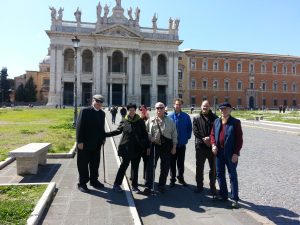
Next, we visit the oldest and first ranking of the four Roman Papal basilicas: St. John Lateran. It is the cathedra or “seat” of the Bishop of Rome (Pope Francis). This was the second papal residence in Rome, and Popes lived here until the 14th century.

We also visit the Holy Stairs, located near the Basilica of St. John Lateran. These are the steps of Pontius Pilate that Jesus ascended in Jerusalem when He was condemned to die. The stairs were moved from Jerusalem to Rome by St. Helena in the 4th century. Also near the Basilica of St. John Lateran is the Basilica of Santa Croce in Gerusalemme (English: Holy Cross in Jerusalem). This basilica contains relics of Jesus’ Passion, including a few thorns from His crown, the nails from His cross, and the sign Pilate fastened above Christ’s head. We visit this church to venerate these sacred relics.
The third Basilica we visit is St. Paul’s Outside-the-Walls. Dedicated to St. Paul, the Apostle to the Gentiles, it enshrines his tomb. Time permitting, we proceed to the Church of St. Paul at the Three Fountains (Chiesa di San Paolo alle Tre Fontane), the site of the martyrdom of St. Paul. Inside, you can see a pillar where St. Paul was, it is said, bound before being martyred. If the gatekeeper is available, the gate may be opened so we may enter and venerate the pillar. We visit the prison cell of St. Paul, where he was held before his martyrdom, in the crypt of another church on the grounds. Tradition says that, because he was a Roman citizen, he was beheaded rather than crucified. The story passed down that his head bounced three times on the ground, and at each spot a spring appeared. The grounds of the Three Fountains are beautiful, prayerful, and quiet. After a busy day, we relax, reflect, and enjoy dinner before retiring to our hotel.
Easter Wednesday, Easter in Italy Pilgrimage: Our last full day together begins with breakfast at the Hotel Michelangelo. We head to the Papal Audience, which begins at 10:30 a.m. During the audience, Pope Francis shares a short instruction and reading in Italian, translated into English, French, German, Spanish, Polish, Portuguese, and sometimes other languages, depending on the groups visiting.
The Pope follows with a greeting to all gathered in St. Peter’s Square. At the end of the audience, the Pope leads us in the Our Father in Latin. This prayer is printed on the back of your Papal Audience ticket. After the Our Father, Pope Francis imparts his Apostolic Blessing upon us and our brothers and sisters here, and extending to our loved ones at home. He also blesses any item that you may have brought or purchased along our journey.
We lunch together near the Vatican, perhaps with an invited guest from the Vatican, enjoying stories about the universal Church. These intimate and insightful encounters remain with pilgrims many years later.

In the late afternoon or early evening, we taxi to the Spanish Steps, the beginning our slow walk to the Trevi Fountain, the Pantheon, and the Piazza Navona. Along the way, we continue to point out many interesting places, peeling away the layers of Roman and Church history.

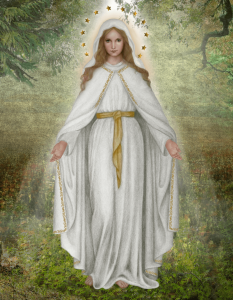
We visit the Basilica of Sant’Andrea delle Fratte, which has a very special side chapel. In 1842 Our Lady appeared here to Alphonse Ratisbonne, an avowed anti-Catholic Jew, manifesting herself exactly as she appears on the Miraculous Medal thus effecting his miraculous conversion. The first Miraculous Medals were struck in 1832 and the devotion was already spreading throughout France after St. Catherine Labouré’s Marian apparition. It was this miraculous apparition to Ratisbonne which provided the impetus to bring the Miraculous Medal devotion to Italy. Many travel from all over the world to visit this shrine and pray at its side altar. This special chapel is also where St. Maximillian Kolbe offered his first Mass on April 29, 1918.
Our farewell dinner, with thoughtful reflections on our Easter in Italy Pilgrimage, hosted by Dr. Robert Moynihan and Deborah Tomlinson, will be at one of our favorite restaurants along this walk. We then return to our hotel, finish any packing, and rest well for our homeward travels. After an early morning Mass, breakfast, and farewell, your driver escorts you back to the airport for your return home. Farewell to all our fellow pilgrims, our friends, until we meet again…