

Lebanon is a small but beautiful country of seacoasts, mountains, rivers – and, of course, majestic cedar trees – with a history stretching back thousands of years, to the Phoenicians, who invented both an alphabet and paper.
Tucked in between Syria and Israel, it is a crossroads between Asia and Europe, a unique land where Christians, Muslims and Jews live together in peace. Christianity took root here in its very beginnings, and Lebanon’s Maronite Catholics are a treasure in the global Church.
Our pilgrimage is not only a journey to holy places, but also a journey within, toward one place only — toward the heart of God, and our own personal unity with Him.
Our itinerary is a living itinerary; each day may hold unexpected encounters. Our prayer is to allow the Holy Spirit to be our guide.
Come with us to this ancient land where Jesus Himself walked …experience Lebanon for yourself: the breathtaking country Pope John Paul II called “a message of peace” for the world.
Pilgrimage Overview
September 19-28, 2026
Our pilgrimage to this “Land of Ancient Faith” will be full of spiritual insight and enriching encounters. We will travel to the Qadisha Valley, the heart of eastern Christian monasticism, and Bkerké, the “Vatican” of Lebanon and the site of the Maronite Patriarchal See. We will witness the extraordinary devotion of the Lebanese Christians to their saints, including St. Charbel, whose monastery we will visit and at whose tomb we will pray.
Day 1
- Arrive in Beirut
- Private transfer to Hilton Grand Hotel (you will be met upon exiting the secured area)
- Immediately check into the Hilton Grand Hotel to rest
- Welcome dinner at the Hilton on the 32nd floor overlooking Beirut and the Mediterranean Sea
Day 2
- Breakfast at the Hilton on the 32nd floor overlooking Beirut and the Mediterranean Sea
- Attend Sunday Liturgy – St Rita’s Church Maronite Liturgy
- Depart for the Qadisha Valley ~ 2 hour drive. Lunch along the way
- Visit St. Anthony Monastery in the Qadisha Valley
The Monastery of St. Anthony is the birthplace of the first printing press in the Middle East. Some historians believe it was built in 1584. Its first printed text is The Book of Psalms, which dates back to 1610. The Lebanese Maronite Order renovated the printing press at the start of the nineteenth century. Its activities were halted at the beginning of the 1860 war. It resumed printing in 1871, but stopped again at the beginning of World War II.
- Dinner will be at our hotel near the Qadisha Valley
Day 3
We will visit many holy sites and encounter many people in the area, including monks and hermits.
- Private Mass at the Mar Lichaa Monastery
- Lunch – once-in-a-lifetime experience dining at a restaurant amongst the trees on the bottom of the Qadisha Valley and along side the rushing Abou Ali River
- Optional hike through the valley to the Qannoubine Monastery and the Grotto of St Marina the Monk
Qadisha Valley (The Holy Valley) The Qadisha Valley cradles centuries of Christian monasticism and the roots of the Maronite church in Lebanon, which date back to the 4th century. According to Unesco: “The Qadisha valley is one of the most important early Christian monastic settlements in the world.”
Day 4
- Visit the Basilica of Saba, a historic and beloved church in Bcharre
- Private Mass at the House of St Charbel, a place deeply connected to the life of Lebanon’s most beloved modern saint
- Visit the Cedars of God: Horsh Arz el-Rab. The cedars in Lebanon are mentioned in the Bible 103 times. One quote from Ezekiel:
“Behold, the Assyrian was a cedar in Lebanon with fair branches, and with a shadowing shroud, and of an high stature; and his top was among the thick boughs”
- Enjoy lunch among the majestic Cedars, a serene and memorable experience in this remarkable mountain region
Day 5
Depart the Qadisha Valley for the coastal town of Batroun. On our way we will visit:
- Monastery of St. Hardidi (1808 – 1858) — a Maronite monk, priest and scholar. He is best known for being the master of St. Charbel
- Monastery of St. Rafca (1832-1914) — a Maronite nun canonized in 2001 by St. John Paul II. She was known for sharing in the suffering of Christ by offering her own suffering of blindness and paralysis to Christ
- Lunch overlooking the sea in Batroun, known for its fresh seafood. Afterward, we will take a tour of Batroun via a golf cart, stopping along the way at churches, the souk, and places of interest.
- Dinner will be on your own in Batroun’s Old Souk, known for its artisan boutiques, cafés, and traditional Lebanese craftsmanship.
- Overnight in Batroun
Day 6
- Private Mass at St. Stephen’s Cathedral, a beautiful church overlooking the harbor of Batroun
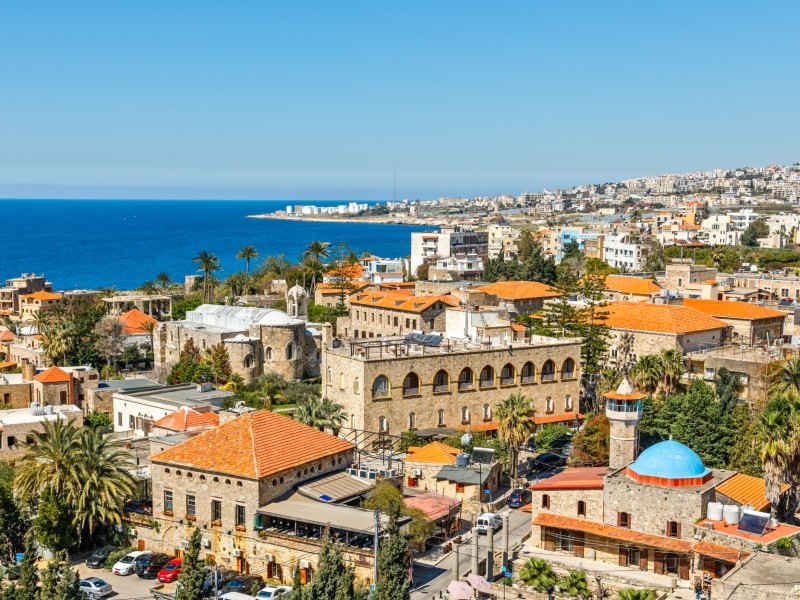
- Depart for the ancient seaside city of Byblos, one of the world’s oldest continuously inhabited towns. Here, we take a golf cart tour and explore its historic port, stone streets, and archaeological sites.
The name Byblos is Greek. Papyrus received its early Greek name (byblos, byblinos) from being exported to the Aegean Sea through Byblos. Hence the English word “Bible” is derived from byblos — “the (papyrus) book.”
- In the late afternoon, we depart for Beirut and check in once again at the Hilton Grand Hotel where we will enjoy dinner on the 32nd floor.
Day 7
- Breakfast at the Hilton on the 32nd floor overlooking Beirut and the Mediterranean Sea
Today, we will visit downtown Beirut:
- Nejmeh Square — the central plaza known for its iconic Ottoman-era clock tower
- Martyr’s Square — a place of deep national memory, home to the bullet-scarred martyrs’ statue and, on many days, rotating art exhibits
- Solidere District — once devastated during the civil war and now restored under the French Mandate plan into a beautiful quarter of cafés, elegant shops, and pedestrian streets
- The many cathedrals in downtown Beirut — St. Nicholas Greek Orthodox Cathedral, St. George Maronite Cathedral, and St. Elias Melkite Greek Catholic Cathedral
- A visit to the Beirut Port, the site of the August 4, 2020, explosion, a place that stands as a testimony to both tragedy and recovery
- We enjoy lunch in the old city of Beirut, followed—time permitting—by a boat tour of the famous Jeita Grotto, a spectacular natural wonder known for its dramatic limestone formations and underground waterways
Day 8
- Breakfast at the Hilton on the 32nd floor overlooking Beirut and the Mediterranean Sea
Today, we will travel a short distance up the mountain to Harissa which overlooks Beirut and the Mediterranean Sea to visit:
- St Paul’s Greek Melkite Basilica, with its striking architecture and sweeping views
- Our Lady of Lebanon, one of the most beloved Marian shrines in the Middle East
- Monastery of Our Lady of Bkerké, the See of the Maronite Patriarchate—often called the Vatican of Lebanon
At Bkerké, we will pray the rosary with Patriarch Rai, the Patriarch of the Maronite Catholics, followed by a personal meeting with him if his schedule allows. Time permitting, we will also visit the Patriarchs’ private museum.
We will have a private Mass at Our Lady of Lebanon, a beautiful setting high above the Bay of Jounieh.
This evening, we gather for a very special dinner at Mounir, an iconic open-air restaurant nestled in the hills overlooking Beirut. Surrounded by lush gardens, stone terraces, and panoramic views of the city lights, Mounir is considered by many to be the finest Lebanese restaurant in all of Lebanon. It is renowned for its traditional mezze, wood-grilled specialties, and warm hospitality—an unforgettable dining experience.
Day 9
- Breakfast at the Hilton on the 32nd floor overlooking Beirut and the Mediterranean Sea
Today, we will travel about an hour north for
- A private Mass at the Monastery of St. Maroun
- We will pray at the Tomb of St. Charbel
- Encounter Father Louis in the Monastery of St. Maroun, who has registered the miracles of St. Charbel for more than 30 years. He will share with us many stories
- Visit the Hermitage of St. Charbel and his cell, which is in the mountains overlooking a lovely valley
- Lunch at the Monastery of St. Maroun, prepared with the food from their garden — a delicious Lebanese meal!
Day 10
- Depart for home from Beirut
