

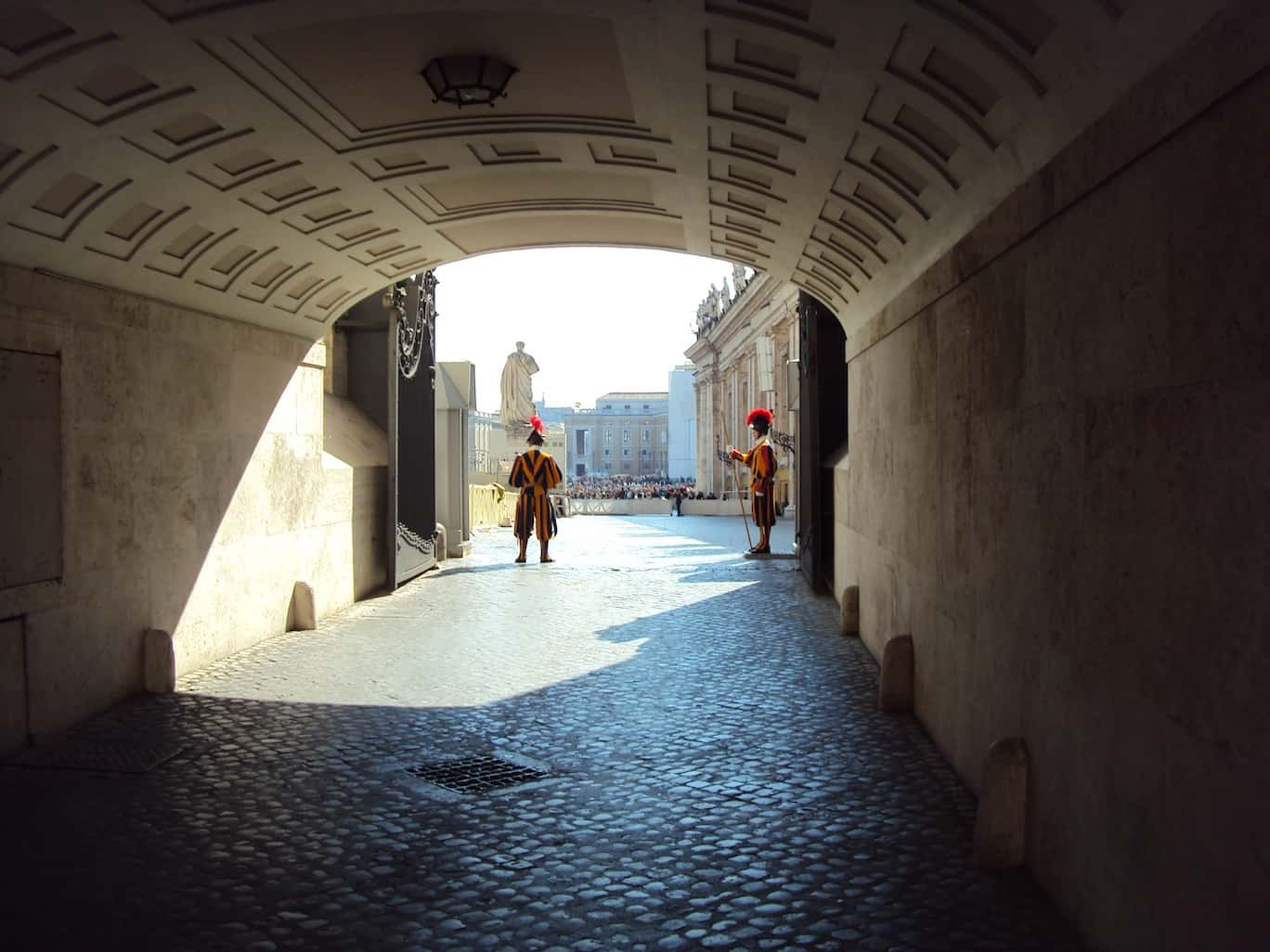
The morning begins in Rome with a clarity that seems particular to the days after Easter. The great solemnities have been celebrated, the alleluias have resounded through the basilicas, and yet the joy of the Resurrection lingers in the air. For a pilgrim traveling with Inside the Vatican Pilgrimages, these days following Easter are not an ending, but a deepening. The liturgy has proclaimed that Christ is risen; now we walk through the city that has guarded and proclaimed that truth for two millennia.
Our day begins quietly at Santa Prassedes. Tucked near the bustle of the Esquiline Hill, this 9th-century basilica preserves some of the most exquisite Byzantine mosaics in the West. Commissioned by Pope Paschal I, the apse presents Christ in glory, robed in gold, surrounded by saints who appear at once solemn and radiant. The church is dedicated to St. Prassede, who, together with her sister, honored the bodies of martyrs during the Roman persecutions. In the days after Easter, standing before these luminous images, one understands that martyrdom was never defeat; it was participation in the victory of the Risen Lord.

By mid-morning, we arrive at the majestic Basilica of Saint Mary Major, one of Rome’s four papal basilicas. Built in the wake of the Council of Ephesus in 431, which affirmed Mary as Theotokos—Mother of God—the basilica stands as a monument to the mystery of the Incarnation. Its 5th-century mosaics narrate salvation history from Abraham onward, culminating in the birth of Christ. After Easter, the connection is unmistakable: the Child born of Mary is the same Lord who has conquered death. Before the revered icon known as Salus Populi Romani, generations of popes have entrusted the Church to the Mother of God. Pilgrims kneel here conscious that the Resurrection is inseparable from the fiat that began it all.
From there, we proceed to the cathedral church of the Bishop of Rome, the Archbasilica of Saint John Lateran.

Basilica of St. John Lateran, Easter in Italy Pilgrimage
Inscribed on its façade are the words declaring it the “Mother and Head of all the Churches of the City and the World.” Within its vast nave, statues of the Apostles stand in solemn witness. The Lateran reminds pilgrims that the Resurrection gave birth to a visible, enduring Church—apostolic in origin and universal in mission. To stand here in the Easter season is to contemplate continuity: the faith preached by Peter and Paul remains alive, proclaimed in every age.
Across the street lies the Scala Sancta, the Holy Stairs traditionally believed to have been ascended by Christ during His Passion. Though the sorrow of Good Friday has passed, pilgrims continue to climb these steps on their knees, meditating on the cost of redemption. In the light of Easter, the ascent takes on a different tone. The Passion is no longer viewed in isolation, but as the path that led to glory. Each prayer offered on those worn steps echoes the Church’s enduring conviction: through suffering came salvation.
The afternoon leads us to Basilica of the Holy Cross in Jerusalem, built to house relics brought from the Holy Land by St. Helena. Within its chapel are fragments traditionally associated with the Passion of Christ. The very earth beneath the altar was said to have been brought from Jerusalem, symbolically uniting Rome to Calvary. Yet in the Easter season, these relics are contemplated not as emblems of tragedy, but as signs of triumph. The Cross is venerated precisely because it has become the instrument of victory.
 Such is a day in the life of a pilgrim in Rome during the Easter season—not a hurried itinerary, but a theological journey through stone, mosaic, relic, and altar. With the guidance of Inside the Vatican Pilgrimages, these sacred sites are not encountered as mere monuments of antiquity, but as living witnesses to the Resurrection. Historical context, spiritual insight, and liturgical awareness converge, enabling pilgrims to perceive the unity of faith and history that defines the Eternal City.
Easter 2026 offers a singular opportunity to experience Rome in the lingering radiance of the Resurrection. To walk these basilicas in the days following the Church’s greatest feast is to understand more profoundly that Christianity is not founded upon an idea, but upon an event. The tomb was empty. The witnesses were transformed. The Church was born.

.
In Rome, that testimony endures in marble and mosaic, in prayer and proclamation. A pilgrimage after Easter is not the conclusion of the celebration; it is an invitation to enter more deeply into the mystery that continues to shape the world.



Leave A Comment
You must be logged in to post a comment.